


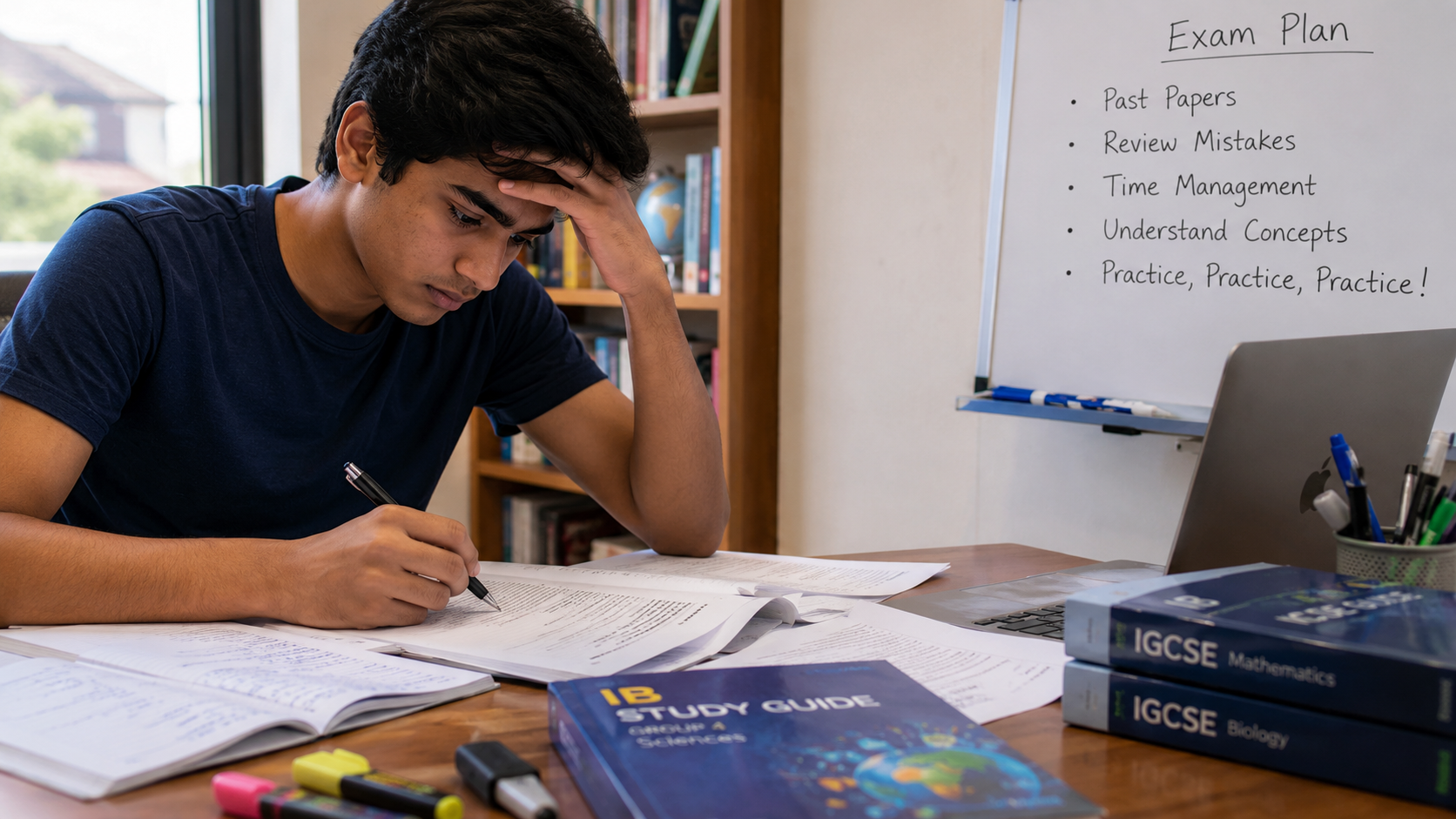
Common IB & IGCSE Mistakes Students Make and How to Avoid Them
Small mistakes in IB and IGCSE exams can have a surprisingly big impact on final grades. Even strong students often lose valuable marks not because they don’t know the content, but because of avoidable errors in revision strategy, exam technique, or time management. The good news is that these mistakes can be fixed with the right awareness and practice.
⏱️ 1. Poor Time Management During Revision
Many students start revising too late or spend too much time on their favorite subjects.
Why it happens: Lack of planning and underestimating exam workload.
Example: A student spends three days revising biology but only a few hours on history.
Solution: Create a balanced weekly timetable and use time blocks. Prioritize weaker subjects and rotate topics regularly.
🧠 2. Relying Only on Memorization Instead of Understanding
Memorizing facts without understanding leads to confusion in application-based questions.
Why it happens: Students feel memorization is faster and safer.
Example: In IGCSE science, a student recalls definitions but cannot explain experiment results.
Solution: Focus on “why” and “how” instead of just “what.” Use diagrams, flashcards with explanations, and teach concepts aloud.
🎯 3. Ignoring Command Words
Words like analyse, evaluate, and describe are often misunderstood.
Why it happens: Students focus on content, not question language.
Example: A student “describes” a process instead of “evaluating” its effectiveness and loses marks.
Solution: Learn command words and practice identifying them in past papers before answering.
📄 4. Not Practicing Past Papers Properly
Past papers are often used incorrectly or too late in revision.
Why it happens: Students treat them as final revision instead of ongoing practice.
Example: A student reads model answers but never attempts full timed papers.
Solution: Start early, simulate exam conditions, and review mistakes carefully after each paper.
✍️ 5. Weak Essay Structure
Poorly structured answers can hide good ideas.
Why it happens: Lack of planning before writing.
Example: In IB English, ideas are repeated without clear introduction or conclusion.
Solution: Use a clear structure: introduction, 2–3 body paragraphs, and conclusion. Plan for 2–3 minutes before writing.
⚠️ 6. Stress and Burnout Before Exams
Overstudying without rest reduces performance.
Why it happens: Fear of failure leads to nonstop studying.
Example: A student studies late into the night before exams and feels exhausted during the test.
Solution: Include breaks, sleep well, and use active revision techniques instead of long passive sessions.
📚 Final Tips for Smarter Revision
- Use active recall instead of rereading notes
- Mix subjects daily (interleaving)
- Review mistakes, not just answers
- Set realistic daily goals
- Stay consistent, not perfect
Success in IB and IGCSE is not just about how much you study, but how effectively you study. By avoiding these common mistakes and building smart revision habits, students can significantly improve both confidence and performance. Stay consistent, practice regularly, and remember—progress is built one focused study session at a time.
Comments
No comments yet. Be the first to comment.
You need to login to write a comment.
Login to comment