



Understanding the Difference Between “Would” and “Used to”
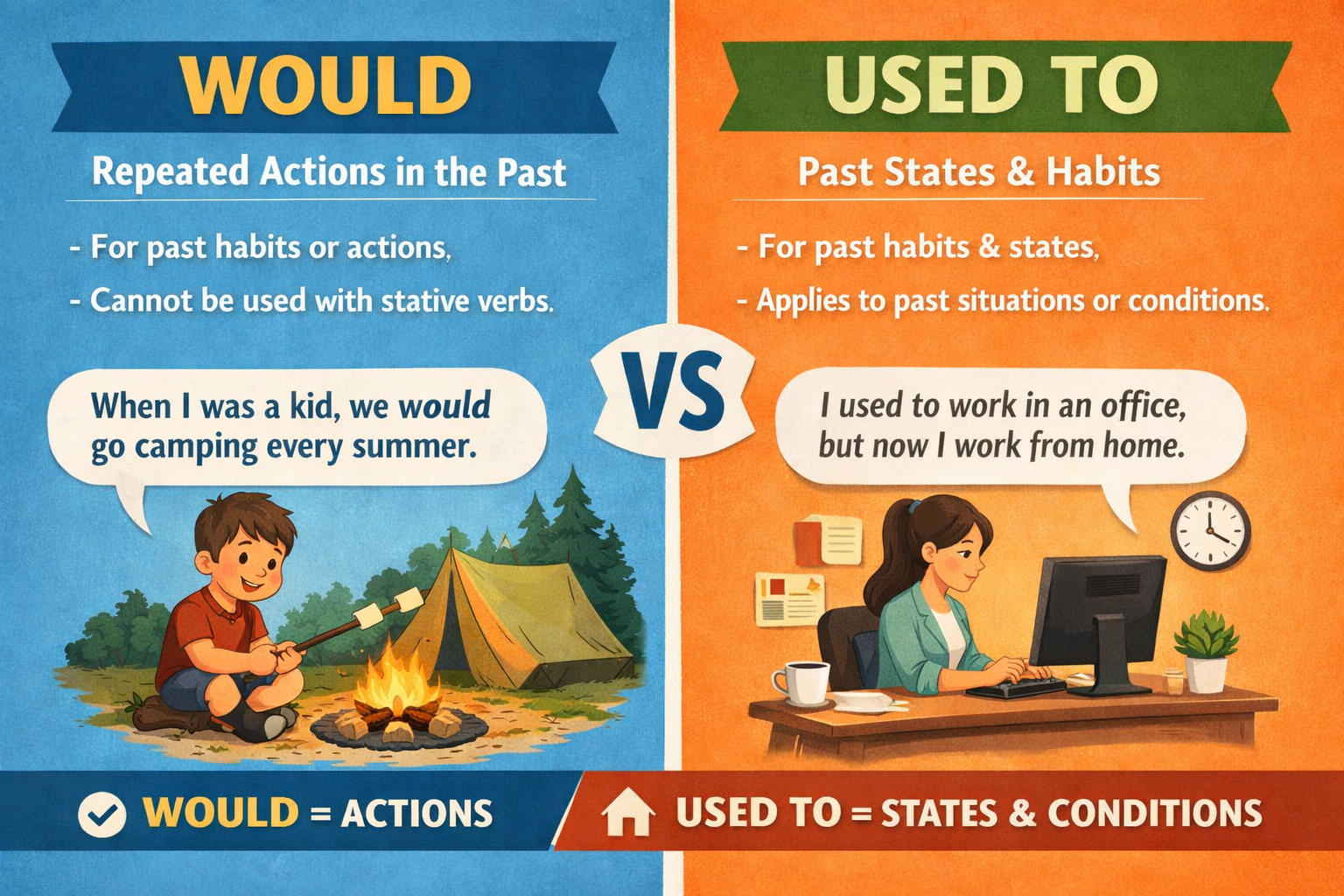
Blog
Understanding the Difference Between “Would” and “Used to”
-
 Tarlan Rasulov
- Mar 10, 2026
- 43 views
Many English learners often confuse how to use “would” and “used to” when forming sentences. One reason for this confusion is that native speakers themselves sometimes use these two expressions interchangeably when talking about past habits. However, even though they overlap in meaning, there are important differences. In this blog, I will clearly explain how to distinguish between these two commonly misunderstood structures.
Understanding the Difference Between “Would” and “Used to”
Many English learners often confuse how to use “would” and “used to” when forming sentences. One reason for this confusion is that native speakers themselves sometimes use these two expressions interchangeably when talking about past habits. However, even though they overlap in meaning, there are important differences. In this blog, I will clearly explain how to distinguish between these two commonly misunderstood structures.
General Observation
It is important to note that “would” is more widespread than “used to,” because would appears in many grammatical structures—such as indirect speech, past future forms, requests, and conditionals. Therefore, its usage extends far beyond describing past habits.
Let’s begin by clarifying the differences between “would” and “used to”, and then explore the other functions of would in detail.
________________________________________
1. Shared Function: Past Regular Actions
Both “would” and “used to” can describe repeated actions or routines in the past which no longer happen now.
Example:
• She used to / would sit in the corner and solve math questions silently.
Here, the action happened regularly in the past but no longer takes place.
However, the key difference is this:
✅ When the past action is a strong habit or a long-term behavior, we normally use used to, not would.
Example:
• He used to smoke.
Smoking is considered a strong, long-lasting habit, so “would” sounds unnatural here. In such cases, used to expresses the idea more clearly.
________________________________________
2. “Used to” + Have → Past Possession (Not Possible With “Would”)
“Used to” can combine with have to show that something existed in the past but does not exist now.
Example:
• I used to have a Rolls-Royce.
This means: I owned it for a period of time in the past, but I no longer have it.
In this meaning, “would” cannot be used.
• ❌ I would have a Rolls-Royce → Incorrect (unless it is a conditional meaning, which is different)
Therefore, whenever we talk about past possession, past states, or long-term situations, only “used to” is correct.
________________________________________
3. Other Uses of “Would” (Where “Used to” Cannot Be Used)
Because would appears in many grammatical structures, it is widely accepted in different contexts. Here are the main additional uses:
a) Indirect Speech
• He said he would come and see me.
b) Past Refusal
• My car wouldn’t start again.
c) Past Future (the future from a past perspective)
• I promised he would bring me some chocolate.
d) Polite Requests
• Would you mind closing the door?
e) Repeated Past Actions
• I would take the exam every month.
f) Conditional Sentences
• I would buy a brand-new car if I had money.
These examples show that “would” serves many functions, far beyond talking about past habits.
________________________________________
Conclusion
Although “would” and “used to” sometimes overlap when describing past actions, they are not fully interchangeable:
• Both can show repeated actions in the past.
• Only “used to” is used for past states (possessions) and long-term habits (e.g., used to smoke, used to have).
• “Would” has many additional uses—including indirect speech, refusal, conditionals, and polite requests.
Understanding these distinctions will help learners use both structures confidently and accurately.
Comments
Comments feature will be added later.